Video analytics were originally hailed as the answer to just about everything in the world of CCTV when it first came to the  fore some years ago . The concept that an intelligent camera that was able  to look at a scene , interpret the difference between human activity and and other forms of movement such as foliage or wildlife was both appealing and very exciting news for the CCTV industry. In essence video analytics spelt the end of the use of PIR sensors and fixed beam technology , manned guarding would be made redundant and the biggest issue of all false alarms would be eliminated.
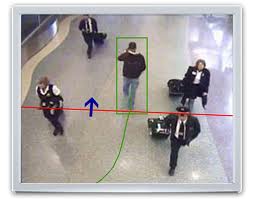
video analytics
As installers of course there is always a learning curve and entering into video analytics at an early stage would be risky but potentially very rewarding. So how did the early pioneers fair ? Well not so good really, Analytics promised much more than it was actually able to achieve . Demonstrations were always impressive but when it came to the real thing, an installation out in the field, false alarms plagued the early external systems.
Internally it was a different storey a more sterile environment coupled with smaller areas of coverage meant that video analytics proved both accurate and rewarding. People counting, intrusions into secure areas and missing objects were easy to both alarm and action so all in all we would highly recommend using video analytics for this purpose i.e  internally .
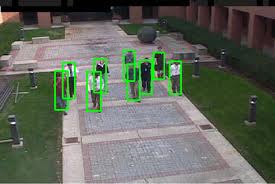
video analytics
Externally though the technology is still blighted to the point where it becomes unusable for unmanned systems . Spiders, rain,snow, moving side curtains on lorries and foliage still seem to be insurmountable issues for the manufacturers although if the system is manned this minor interference is nothing but a nuisance factor for an operator .
So in summary, internally brilliant. Used in conjunction with manned security then it is satisfactory . Unmanned for remote monitoring  we are afraid to say video analytics  still have a long way to go , in fact there has to be doubt whether it will ever be reliable enough  at all .
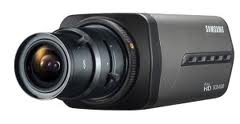
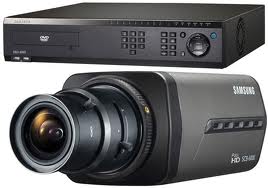
Well its been a while coming but Samsung are finally starting to promote their Samsung HD-SDI CCTV solutions to the wider market. We have seen the SCB-6000  HD-SDI camera before and this is well priced at around £370 . A full box camera, with day/night operation has been enhanced thanks to the new WiseNetII DSP chipset . This helps deliver a noise reduction system that eliminates noise without causing ghosting . In addition the SSDR super dynamic feature increases detail in dark areas. Also within the Samsung HD-SDI range is the SCD 6080 full HD dome camera.

The Samsung HD -SDI recording solution is currently in form of a 4 channel HD -SDI DVR . The SRD-480D is again a full HD resolution recorder that gives us clear sharp images on playback. A price of around £1875 means that it competes well with other HD-SDI DVR’s in its class.

Available from most leading distributors such as AASSET, ADI, Norbain and Provision, Samsung are finally begining to advertise and push HD SDI as great way to get HD CCTV over coax the perfect solution for upgrades to analogue CCTV systems.

One thing that is not contested in the CCTV market place today is that HD CCTV is inevitable. It is the natural upgrade path for pretty much every CCTV system out there and the results that can be achieved using HD cameras are superb. HD CCTV gives the end user what they want and to this end as Avigilon rightly say “the evidence is clear”.

What however is less clear is how this upgrade path to HD will be achieved. It has to be mentioned that when it comes to an IP solution Avigilon are clearly the market leaders. Their equipment is second to none but their approach to the market place is unique. Selling encoders and software is their number one priority. After all once they have their recording software in place the end user will not go back to a DVR and they will happily add their legacy analogue cameras into the system until the camera either fails or the budget can be put in place to take the next step and upgrade to HD.

The flexibility of their VMS solution is second to none and they appear to have left the competition in their wake. The HD cameras are well built, come in various formats that allow them to be sold into small as well as large system solutions. We have to question just who is their closet rival ?

The only rival we can foresee is in fact a completely different technology but one that still provides an HD solution. This is HD CCTV over coax. Perhaps the most interesting thing about HD CCTV over coax though is that no real market leader has yet to emerge. Yes Everfocus were probably first on the scene but they do not seem to have forced their advantage from the early days into actual sales.

This has allowed scores of new entrants to try their luck in the field of HD CCTV over coax. Calsys, Win4net, Ctring and the biggest name Samsung as well as other Chinese and Korean companies are all trying but none have emerged yet as clear market leaders. This gap in the market will be filled and soon but who can really grab the nettle. The efforts of the HD CCTV alliance to standardize the technology mean those who have subscibed seem to be getting more exposure. In addition once HD SDI can be transmitted over CAT5 and rumours persist the alliance expect this to be in the very near future, the scope for HD SDI becomes huge, so watch this space.

So where does this leave us with the question of HD IP and Avigilon verses HD CCTV over coax. Well Avigilon will find more and more willing participants in their HD revolution but price will still dictate that it will be bigger CCTV systems and IP projects that will more happily fit their profile. HD CCTV in the meantime is finding a niche in 2,4 and 8 camera systems. HD SDi DVR s seem to be most in demand for existing analogue systems in smaller retail, industrial estate type scenarios. To this end the take up on smaller existing systems is the market they are picking up. The technology of HD SDI is providing some great results and with it some happy customers.

There is a long way to go and we look forward to who will win the battle to become the number 1 supplier in HD CCTV over coax. In the meantime Avigilon have certainly laid claim to their place as the number 1 in HD over IP. Can anyone challenge that out their?

Win4net have finally made their entrance into the HD SDI DVR arena with their new 2 way HD-SDI recorder. This compact unit is the first 2 way unit in the market place and is looking to pick up on the upgrade business of HD CCTV over coax. Win4net have added the FD02 to their Trium range and this unit is designed to work on the NVMS software platform that has done so well for them with their traditional analogue DVR. In fact the plan for this little 2 way HD- SDI unit is to use two analogue outputs to link it up with existing systems currently running the software. This means the end user gets local HD quality recordings but still has the ability to have the cameras monitored remotely in an analogue format, meaning images stream easily to the central station not restricted by huge data bundles.

The Trium FD02 2 way HD SDI DVR has space for two 3 TB hard drives giving it capacity for over 20 days recording space for both cameras at full def and 30FPS. The playback quality is quite simply stunning. Detail is crisp and clear and objects, number plates and faces can be clearly picked out in playback mode. The FD02 has the ability to be able to zoom in at up to 8x and lose minimal definition.

The best part of the HD CCTV solution is the price. HD CCTV at budget prices. Win4net have taken a risk with this unit in terms of the fact that its only going to be able to record 2 HD SDI cameras. Is this enough? Well if you are just looking to record a gateway and an entrance doorway this is the DVR you want. More cameras just means the units get stacked and a staged upgrade is the best way to improve your existing analogue CCTV system and control costs and target key areas to deploy HD CCTV.

So Wn4net have made their commitment to HD-SDI CCTV and judging by the feedback its a very good product.

Trium FD02 HD SDI DVR

The shocking news that Norbain have found themselves in such a difficult situation over the last few days is lesson to all in the industry. The reasons given for the the demise of old Norbain were clear and unequivocal. Quite simply the industry has taken a downturn. New projects are on hold and new sales are just not materializing from any other source.

Some time ago now Norbain chose to take the route away from analogue products and “focus” on IP security equipment. This was based on industry predictions that all CCTV and security would be IP based in the very near future , tipping point has been predicted by Norbain as 2013. This has simply not happened and the evidence is clear that for the CCTV industry to cope with both a downturn in demand and new competition from IT integrators it has to learn lessons and change very very quickly.

Products need to be cutting edge, sales techniques changed with more online sales and support being a move forward but one that must be mixed with a good old fashioned voice on the end of a phone when its needed. More than this though the public have been let down too many times by poor results when video evidence is required. The frustration felt by small business as well as the public in high profile cases is immense when they are seeing poor images with the chance of any type of  identification laughable. That’s the weakness of course of analogue and why Norbain were keen to move to IP and with IP comes HD video.

This is the way forward, HD CCTV solutions must be sold in future if the industry is regain the faith of the UK public. Cheap analogue solutions are killing the industry. IP and HD was Norbain’s vision and with true integration achievable between all IP security products such as CCTV, access control and intruder alarms the idea was definitely a good plan. The problem is the adoption of IP by the CCTV industry itself has been slow to non-existent.

We advocate that HD is the way forward to. HD however over coax is a simpler and cheaper solution in many cases than IP. Using existing coax and still achieving HD images is highly beneficial to the end user where a new IP infrastructure is not practical.

So the lesson that needs to be learnt is to give the end users crisp clear images, give them evidence they can use. Make CCTV a desirable purchase once more, after all everyone agrees the concept is a good one. This goal can be achieved but it can only be achieved with the deployment of  HD in as many applications as possible.