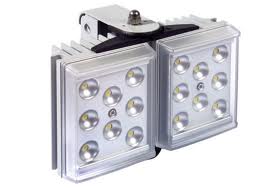
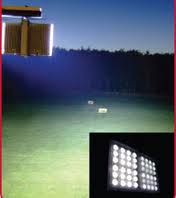
Nights are drawing in and HD CCTV systems installed over the summer will start to be tested in real night time conditions.
It will be advisable for all who have just had or are about to have a HD CCTV system installed to think hard about how important lighting will be this winter. The problem that this will overcome is that most CCTV systems out there still use halogen lighting systems, generally tripped by a PIR. Now these lights are cheap to buy and relatively cheap to install, but they quite simply do not last. Its actually not the installers fault. Quality of all halogen lighting decreased as suppliers strived to offer very cheap lighting. The home DIY market has ensured that any light costing more than £10 means no one will pay for it. Its a shame because some years ago tungsten halogen lighting was made to a high standard and lights and bulbs would last forever. Unfortunately these good manufacturers were put out of business by cheap imports.
So the solution is lighting using led technology. These lights are cleverly designed and reliable. A huge marketing campaign has ensured that led lighting is now being used especially when it comes to HD CCTV. Ergonomic design ensures they look good and they give fantastic results.In addition Clarius led lighting gives great light spread and reduced costs once installed. The only issue is the cost of the initial installation compared to halogen, however in the case of HD CCTV we believe you actually get what you pay for.
So remember megapixel IP cameras and CMOS chips in HD CCTV cameras perform much less efficiently in the dark than analogue CCTV cameras as a result lighting has become much more important. The shift to HD CCTV will demand good lighting products and it will be beneficial to end users as there night time images will improve as a result.
The time has come for an upgrade and your company has decided that they want HD CCTV images instead of analogue that has served them well for a number of years but just does not provide the definition that you need anymore.
So how do you decide which path to take for your upgrade? There are so many choices out there and mixed messages. However each site is individual and each company will have their own specific requirements so here are a couple of questions you should be asking before starting.
Do you need the CCTV system to be for one one site or a group of sites spread across the country/world?
If the answer is just one site then you should perhaps be considering HD SDI CCTV, especially if it is an upgrade and you have existing coax in place. If you wish to view the CCTV from anywhere and across several different sites then IP may well be the first port of call.
Do you want to keep existing cameras but upgrade just a few to HD?
Again we have two ways to approach this. We can install a Hybrid HD SDI DVR this will enable us to put new HD SDI cameras on existing coax and leave other analogue in place. Alternatively we can put encoders in place that will convert existing analogue cameras to IP and then add HD IP cameras in our designated new positions. However if existing coaxial infrastructure is in place then HD-SDI CCTV has to be the favorite.
By asking yourself the above questions the choice will become clearer and HD SDI is becoming cheaper and cheaper. We would recommend that if you do chose an HD SDI option you look for both cameras and DVRs that have been endorsed by the HDcctv alliance (logo above). The reason is simple, you know it will work. What is more it will always work with any HDcctv approved equipment if you chose to expand in the future.
Surveillance Equipment Chip Makers Invest US$30m in HDcctv Compliance HDcctv.
News that HDcctv Alliance chip-maker Member companies have committed more than $30m to deliver chips for HDcctv compliant surveillance equipment in the coming year will certainly make many in the CCTV industry sit up and take notice. The press release at 0900 Australian Eastern Standard Time today, announced that four of its industry leading semiconductor Member companies have committed more than thirty million US dollars into the development, manufacture, and marketing of chips that will enable HDcctv-compliant equipment to be manufactured more cost effectively.
HDcctv uniting HD cctv over coax
So how have sales grown?
HDcctv camera and DVR sales have grown expodentially from zero sales in 2009 to over 150,000 units sold so far this year. Continued growth demands 100% multi-vendor interoperability, which HDcctv compliance certification ensures. The 4 companies involved, EqcoLogic, Eyenix, Nextchip, and Semtech today revealed the rollout timeline for ten newly designed chips for cameras and DVRs that will facilitate HDcctv compliance certification. These chips,scheduled to be in the hands of CCTV equipment designers in 2013, will make it more likely that HD surveillance equipment can be certified HDcctv compliant and will interoperate freely out of the box. Something all installers should welcome.
Availability of chips implementing the HDcctv standard accelerates the HD surveillance market, one that is already seeing massive interest. Conventional CCTV systems are designed by security installers, who mix and match surveillance products made by various manufacturers. Time spent adjusting cameras and DVRs to begin capturing video is part of an installer’s costs. If HDcctv cameras and DVRs do not work together straight out of the box, the installer’s costs rise. HDcctv compliance ensures that products from various manufacturers will interoperate upon power-up. Compliance certification is important to all installers and manufacturers. For installers, the compliance mark in a product brief means plug-and-play, which holds down costs. For manufacturers and their OEM customers, compliance certification means fewer no-fault-found returns, this increases profit and must be welcomed.
Interoperability.
To be certified HDcctv compliant and eliminate any doubts about transmission performance and interoperability, a camera or DVR must implement certain functions. Chips that power today’s HDcctv products were designed before the HDcctv 1.0 standard had been defined, so they did not necessarily have the functions embedded that are required for compliance certification. This means that a large proportion of Generation 1 HDcctv cameras cannot be certified compliant. HDcctv equipment buyers will benefit from Generation 2 HDcctv chips implementing the functions needed for compliance certification. There are ten Generation 2 semiconductor products listed and these represent a total investment in chip design, semiconductor manufacturing ramp, and customer assistance that exceeds 30 million U.S. dollars.
Quotes from Industry Leaders
Don Shaver, Semtech marketing director says “Early on, we delivered chips that made it easy for development teams to migrate CCTV cameras and DVRs , but it took three years for most of the world’s CCTV equipment factories to produce at least one Generation 1 HDcctv model,”. “As a founder and Steering Member of the HDcctv Alliance, Semtech has led the HDcctv standard definition process. Semtech’s GV7601A is the industry’s first fully integrated receiver that implements extended reach (XR) capability. GV7601A and other Generation 2 products targeting HDcctv compliance will impact the end market more quickly than Generation 1 products have, because security installers are seeing the simplicity of HDcctv and have experienced high-quality HDcctv live views for themselves.” “We recognized the potential for the HDcctv market very early,” commented Hweihn Chung, Nextchip R&D director. “Too early, in that we weren’t able to provide for HDcctv compliance in NVP2400. We are excited that our NVP2410 chip (‘Eagle2’) – already on our customers’ lab benches – can implement pathological test pattern generation, CRC, StreamID, and so forth. This means Eagle2-based HDcctv cameras will pass all HDcctv compliance tests, provided that the camera-internal electrical pathways are implemented correctly.” “Interoperability among manufacturers’ equipment is essential for the HD surveillance market to reach its growth potential,” observed Peter Helfet, CEO of EqcoLogic. “EqcoLogic has a track record of leading the development of standards, and we are proud to make a significant technical contribution to the HDcctv 2.0 physical layer definition. As the surveillance market continues to migrate to HD, we anticipate widespread adoption of our QCO30T/R5-XR chips, and we are committed to enabling interoperability of all our customers’ HDcctv products.”
“Eyenix is proud to support the HDcctv Alliance. Standards compliance means an out-of-the-box plug-and play customer experience, which, in turn, drives sales,” said Dr. Jon Hwang, CEO of Eyenix. “In addition to providing for camera compliance certification in our EN777 chip, Eyenix is excited to offer a multi-channel receiver ASIC chip for HDcctv-compliant DVRs. Our investors see enormous potential for HDcctv semiconductor sales.” “Security customers care about colour reproduction, sensitivity, sharpness, dynamic range, privacy masking, ease of use, and so on,” commented Todd Rockoff, executive director of the HDcctv Alliance. “Local-site video transport technology becomes a direct concern to customers only when it creates problems such as arise from non-interoperability,” he continued. “An equipment executive’s first reflex is to differentiate his products from those of the other manufacturers. The Alliance’s mission is to encourage competitors to overcome that reflex and cooperate when it comes to device interface technology. We’re working to help makers’ executives appreciate that everyone – customers, installers, and competing manufacturers alike – benefits from the interoperability that HDcctv compliance certification ensures.”
Generation 1 HDcctv products incorporate chips whose designs pre-date HDcctv 1.0 • Most pre-HDcctv-1.0 chips do not implement all the functions needed to certify a camera as HDcctv compliant.
Why are HDcctv camera prices similar to those of CCTV cameras? •
The camera architecture and dominant make-cost factors in HDcctv and CCTV cameras are identical, so manufacturing costs are very close at similar volumes.
Why do Generation 1 HDcctv DVRs cost more than CCTV DVRs? •
HDcctv presents 6 times as many pixels to process • HDcctv presents 6 times as many pixels to store •
No specialized multi-channel receiver (RX) chips were available when Generation 1 HDcctv DVRs were designed.
Why do manufacturers expect Generation 2 HDcctv DVRs to cost about the same as CCTV DVRs?
More pixels to process than CCTV: Higher-performance pixel-processing chips are now available • More pixels to store: Hard disk drive prices are declining; meanwhile, compression chip performance is increasing (even as prices continue to decline) • Need specialized multi-channel receiver (RX) chips.
The first HDcctv-ready Quad Receiver ASIC was introduced in April 2012.
What are the advantages of HDcctv cameras over MP IP cameras?
HDcctv cameras deliver the highest-quality HD live views • HDcctv cameras and DVRs are as easy as regular CCTV cameras and DVRs to install and set up • HDcctv cameras and DVRs can usually re-use legacy cabling.
What are the disadvantages of HDcctv cameras for HD surveillance?
HDcctv cameras can be more expensive than MP IP cameras for large spaces that are sparsely covered with cameras • No wireless solution is yet available for HDcctv • HDcctv cameras transmit only HDTV video: 720p25/30/50/60 and 1080p25/30. Customers who need higher frame rates or higher resolution must turn to MP IP cameras.
How much has each company committed to each product?
The semiconductor manufacturers have not published this information on an individual basis • A typical fabless semiconductor product requires about US$10m investment from design start to mass production ramp • US$30m for the ten Generation 2 chips is therefore likely a very conservative estimate.
Certified HDcctv-compliant products.
Only certified HDcctv-compliant products bear the distinctive HDcctv compliance mark, which guarantees electrical transmission characteristics, interoperability with other manufacturers’ HDcctv-compliant products, and compatibility with future-generation compliant products.
Useful links:
• Alliance membership list www.highdefcctv.org• Technical specification http://www.highdefcctv.org/hdcctv-specification•
Compliant product finder http://www.highdefcctv.org/compliant-product-finder • Upcoming events http://www.highdefcctv.org/eventso Schedule a meeting with a Member or executive director Todd Rockoff at [email protected] HDcctv Alliance Media Contact: Leslie-Ann Campbell +1-408-680-6023 [email protected]
Who is involved?
EqcoLogic.
EqcoLogic is a Belgian company, founded in 2005. The company is commercializing innovative equalizer and transceiver technology in numerous markets including machine vision, medical, security and automotive. EqcoLogic is a fabless semiconductor manufacturer, and the company also licenses its core technologies and product designs in certain markets. For more information, please visit www.eqcologic.com
EqcoLogic Media Contacts: Americas time zones: Zeph Freeman +1 (972) 607-4113 [email protected] Europe time zones: Peter Helfet +32 2 629 1301 [email protected].
Eyenix
Founded in 2002, Eyenix provides systems-on-chips that differentiate cameras for several industries including security, camcorder and mobile imaging. Eyenix develops unique intellectual property through diverse customer needs analysis, drawing on both theoretical mathematics and practical advanced engineering methods to deliver finely crafted solutions. One of the world’s leading ASIC image signal processor (ISP) chip vendors, Eyenix has shipped more than 10 million ISP chips to security camera manufacturers. Eyenix Media Contact: Monica B. Yang +82-3-1204-7333 (ext. 110) [email protected]
Nextchip
A fabless semiconductor company founded in 1997, Nextchip specializes in the design of multimedia chips. Nextchip stands among the few leading chip makers in the video surveillance industry and produces image processing chips used in CCTV cameras, DVRs, IP cameras, and other related products. With the goal of becoming the world’s number one company specializing in video processing, Nextchip has developed unique core technologies for video processing over more than 15 years of R&D investment. This intellectual property has positioned Nextchip as the only semiconductor company that possesses all thecore technologies for video surveillance systems, including ISP, Decoder, Vertical Driver, CCD, AFE, SoC, Software platform, etc. Nextchip offers a broad array of semiconductors ranging from highest performance to most economical and can quickly tailor solutions in collaboration with its customers. Nextchip Media Contact: Young-Jun Yoo 유영준+82-2-3460-4700 [email protected]
Semtech
Semtech Corporation is a leading supplier of analog and mixed-signal semiconductors for high-end consumer, computing, communications and industrial equipment. Products are designed to benefit the engineering community as well as the global community. The company is dedicated to reducing the impact it and its products have on the environment. Internal green programs seek to reduce waste through material and manufacturing control, use of green technology and designing for resource reduction. Publicly traded since 1967, Semtech is listed on the NASDAQ Global Select Market under the symbol SMTC. For more information, visit http://www.semtech.com/. Semtech, the Semtech logo, and Gennum are registered marks of Semtech Corporation. Semtech Media Contact: Pauline Cadena +1 (805) 389-2755 [email protected]
In summary.
HDcctv has come a long way in a very short time. HDcctv will and has already revolutionised the industry. Images over coax that were previously thought impossible are now the norm. Innovators who have been given a very rough ride have proved that “the third way” could well be the best way. To get this sort of investment is hardly a surprise. HDcctv is here to stay.
One thing that is not contested in the CCTV market place today is that HD CCTV is inevitable. It is the natural upgrade path for pretty much every CCTV system out there and the results that can be achieved using HD cameras are superb. HD CCTV gives the end user what they want and to this end as Avigilon rightly say “the evidence is clear”.
What however is less clear is how this upgrade path to HD will be achieved. It has to be mentioned that when it comes to an IP solution Avigilon are clearly the market leaders. Their equipment is second to none but their approach to the market place is unique. Selling encoders and software is their number one priority. After all once they have their recording software in place the end user will not go back to a DVR and they will happily add their legacy analogue cameras into the system until the camera either fails or the budget can be put in place to take the next step and upgrade to HD.
The flexibility of their VMS solution is second to none and they appear to have left the competition in their wake. The HD cameras are well built, come in various formats that allow them to be sold into small as well as large system solutions. We have to question just who is their closet rival ?
The only rival we can foresee is in fact a completely different technology but one that still provides an HD solution. This is HD CCTV over coax. Perhaps the most interesting thing about HD CCTV over coax though is that no real market leader has yet to emerge. Yes Everfocus were probably first on the scene but they do not seem to have forced their advantage from the early days into actual sales.
This has allowed scores of new entrants to try their luck in the field of HD CCTV over coax. Calsys, Win4net, Ctring and the biggest name Samsung as well as other Chinese and Korean companies are all trying but none have emerged yet as clear market leaders. This gap in the market will be filled and soon but who can really grab the nettle. The efforts of the HD CCTV alliance to standardize the technology mean those who have subscibed seem to be getting more exposure. In addition once HD SDI can be transmitted over CAT5 and rumours persist the alliance expect this to be in the very near future, the scope for HD SDI becomes huge, so watch this space.
So where does this leave us with the question of HD IP and Avigilon verses HD CCTV over coax. Well Avigilon will find more and more willing participants in their HD revolution but price will still dictate that it will be bigger CCTV systems and IP projects that will more happily fit their profile. HD CCTV in the meantime is finding a niche in 2,4 and 8 camera systems. HD SDi DVR s seem to be most in demand for existing analogue systems in smaller retail, industrial estate type scenarios. To this end the take up on smaller existing systems is the market they are picking up. The technology of HD SDI is providing some great results and with it some happy customers.
There is a long way to go and we look forward to who will win the battle to become the number 1 supplier in HD CCTV over coax. In the meantime Avigilon have certainly laid claim to their place as the number 1 in HD over IP. Can anyone challenge that out their?
Win4net have finally made their entrance into the HD SDI DVR arena with their new 2 way HD-SDI recorder. This compact unit is the first 2 way unit in the market place and is looking to pick up on the upgrade business of HD CCTV over coax. Win4net have added the FD02 to their Trium range and this unit is designed to work on the NVMS software platform that has done so well for them with their traditional analogue DVR. In fact the plan for this little 2 way HD- SDI unit is to use two analogue outputs to link it up with existing systems currently running the software. This means the end user gets local HD quality recordings but still has the ability to have the cameras monitored remotely in an analogue format, meaning images stream easily to the central station not restricted by huge data bundles.
The Trium FD02 2 way HD SDI DVR has space for two 3 TB hard drives giving it capacity for over 20 days recording space for both cameras at full def and 30FPS. The playback quality is quite simply stunning. Detail is crisp and clear and objects, number plates and faces can be clearly picked out in playback mode. The FD02 has the ability to be able to zoom in at up to 8x and lose minimal definition.
The best part of the HD CCTV solution is the price. HD CCTV at budget prices. Win4net have taken a risk with this unit in terms of the fact that its only going to be able to record 2 HD SDI cameras. Is this enough? Well if you are just looking to record a gateway and an entrance doorway this is the DVR you want. More cameras just means the units get stacked and a staged upgrade is the best way to improve your existing analogue CCTV system and control costs and target key areas to deploy HD CCTV.
So Wn4net have made their commitment to HD-SDI CCTV and judging by the feedback its a very good product.