Today we publish more of our fascinating interview with Todd Rockoff on the merits of  HDcctv as a technology. It is fast becoming the most efficient and cost effective way of delivering HD images into the security market place. Today we touch on chip technology and how having some of the most innovative chip manufacturers on board is helping the HDcctv alliance build its brand and persuade more of the security community to accept that HD over coax is ultimately the best way forward for CCTV security professionals. For previous questions click here

6) We hear of major developments with regard to chip technology that
will make HDcctv both better and cheaper. Can you outline exactly what
the benefits will be and when it will be available?

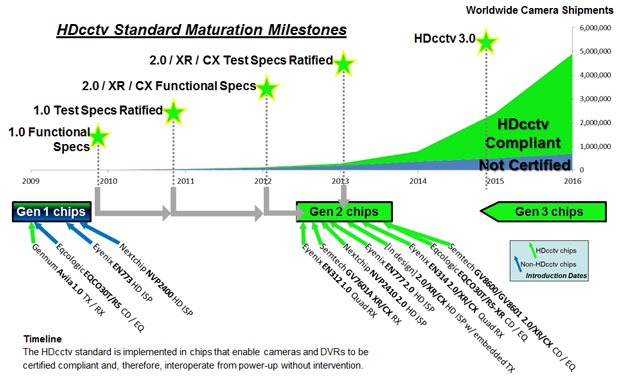
TR: Most of the leading semiconductor players in the surveillance industry, including two of the world’s top three ISP vendors, are implementing the features needed for HDcctv compliance in their current-generation chips. This industry development means that HDcctv compliance is becoming easier for device manufacturers to achieve.
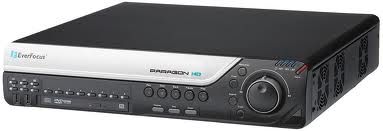
Meanwhile, more than one HDcctv Alliance chip-maker Member has developed a multi-channel receiver chip for HDcctv-compliant DVRs. Multi-channel receiver chips are part of the answer as to why CCTV DVRs are so cost effective. As the multi-channel receiver chips become readily available to HDcctv DVR makers, HDcctv DVRs will be better able to compete head-to-head with CCTV DVRs with respect to make cost.
Currently, most DVRs implement HDMI outputs. HDcctv is better for surveillance than HDMI, because it is less expensive per port and carries signals over longer distances. For these reasons, and as costs continue to come down as the industry scales the learning curve, native HDcctv monitors are expected to become increasingly popular.
HDcctv chip migration


7) You have campaigned long and hard to convince the industry that
HDcctv compliance is the way forward. Few disagree but is there signs
of more members coming on board and do you think by not joining
manufacturers who are just selling HD SDI without standardizing risk
being marginalized.

TR: The surveillance market is moving toward HD video, whatever the transport technology. We have campaigned long and hard to convince the industry that HDcctv is a superior alternative to MP IP cameras in many cases, and the fact that an outright majority of the world’s CCTV manufacturers has already embraced HDcctv in some form validates the HDcctv value proposition, which seemed so controversial just four years ago: HDcctv is easy to design and manufacture while cost-effectively delivering typically excellent end-user experiences.
Installers who buy surveillance equipment through distribution expect 100% multi-vendor interoperability and assured electrical performance. These properties are essential to be able to mix and match products from disparate manufacturers. Since distribution accounts for more than 80% of all cameras sold worldwide, these properties are economically significant. HDcctv compliance certification is the only way a manufacturer can warrant 100% multi-vendor interoperability and certain electrical performance. The various interpretations of HD-SDI get partway there, delivering HD video in some way, but there is no compliance certification regime for any of the HD-SDI variants.
The steady growth of the HDcctv Alliance reflects an inevitability that most manufacturers will ultimately seek HDcctv compliance certification for their HDcctv products, because testing to the international standard is required for a manufacturer to be able to warrant interoperability and electrical performance, and these properties are essential for sales through distribution. HD-SDI was developed to meet the needs of broadcast television studios, rather than surveillance. The need for compliance certification becomes even more important for those manufacturers seeking to take advantage of the advanced, surveillance-specific capabilities of HDcctv 2.0/CX/XR.
What does it mean for a manufacturer to ship a proprietary interpretation of HD-SDI instead of embracing HDcctv, the global standard? It may be that the manufacturer is grappling with the technical issues that inevitably arise for the first products in a new product category and has not yet placed a high priority on compliance certification. Ultimately, given that compliance certification is valuable and not intrinsically expensive, persistently refusing to certify compliance might raise questions in some buyers’ minds about the manufacturer’s overall commitment to quality.

8) This year at Ifsec the bias towards HD over coax was obvious and
Samsung are one of the big names we see that are almost reluctantly
deciding they have to join the fray. Why the reluctance originally on
their part?. Will they be joining the alliance? And are there other
big name manufacturers waiting in the wings to launch HDcctv over
coax?

TR: I cannot comment on any non-Member’s plans. In general, the fundamental economic considerations discussed above motivate every manufacturer hoping to sell HDcctv products through distribution to seek HDcctv compliance certification at some point during the manufacturing engineering cycle.
You raise a fascinating question that has significant implications for our industry: Despite a few notable exceptions, why have the incumbents largely abandoned the HDcctv market opportunity to more nimble competitors, in favour of focusing only on MP IP cameras? There certainly are situations where IP cameras are convenient and cost effective, but not every situation. After some 15 years of trying and failing to gain significant market share, the one area where IP cameras have been beating CCTV cameras in recent years has been HD surveillance. When MP IP cameras were the only option for HD surveillance, it was easy to mistake the market migration to HD surveillance as the beginnings of a long-awaited mass migration to IP cameras, and many companies built their long-term strategies around the ultimate dominance of IP cameras. It can be difficult for a company, having made a huge investment developing IP cameras and educating installers to use IP cameras in all cases, to consider an alternative, no matter that HDcctv is a more practical path to HD surveillance in many situations. That is one reason why the incumbents have been hesitant to embrace HDcctv. Meanwhile, smaller and more agile companies are delivering HDcctv solutions to meet the market need for HD without the I.T. issues introduced by IP cameras.
Ultimately, surveillance product innovation is delivered in semiconductors. The HDcctv Alliance includes about 15 chip-maker Members collaborating on defining the standard and implementing the standard’s features in their chips. As those chips become ever more widely available, expect an ever-growing number of equipment brands to begin to take advantage of the capabilities in their product lines.
HDcctv technology is already in the process of disrupting the competitive landscape in the surveillance industry: those failing to offer HDcctv solutions are missing out of one of the most dynamic product categories ever to hit the industry.
Thankyou Todd Integrated CCTV will have more of the interview and insight into the HDcctv alliance shortly

HDcctv is evolving at an incredible rate.  We have already discussed how the HDcctv alliance is guiding installers on the use of megapixel lenses in order to ensure the best images possible. Today as we further question Todd about HDcctv and where it is all heading , we wanted to know how the HDcctv alliance is addressing the future and how it will continue to challenge other technologies in order to ensure HDcctv over coax continues to be an attractive option for HD upgrades for installers and end users alike. We continued the interview by asking about Remote monitoring of HDcctv.

HDcctv Alliance logo
HDcctv


2) With HDcctv Recorders a lot of focus is spent on the quality of

locally recorded images and this obviously affects bandwidth and
storage – but there is a huge market for remote monitoring that
analogue covers right now, will recorder manufacturers consider
features such as throttled/reduced quality transmission for remote
monitoring?

HD SDI over coax

TR: Certainly, HDcctv DVRs typically provide all the remote IP video capabilities of conventional CCTV DVRs. DVRs typically allow the operator to specify the tradeoffs among transmitted frame rate, resolution, and quality (amount of compression) to optimize the use of available off-site bandwidth. One of the appealing aspects of DVR-based architecture is that the DVR allows those bandwidth optimization tradeoffs for all cameras on the local site to be managed in one device; with MP IP cameras, by comparison, optimizing the use of available off-site bandwidth requires carefully configuring each IP camera, as well as possibly the NVR, in a harmonized manner.

3 ) Is it possible for MP resolution to increase in the future and if
not will HDcctv be able to compete with ever increasing IP camera
resolutions at decreasing prices?

TR: There are two ways in which the HDcctv standard is addressing higher-than-1080 resolution video.
In the near term, HDcctv 2.0, due to be completed in early 2013, provides for a 75Mb/s data stream to be transmitted from the camera in parallel with uncompressed HDTV signal. An HDcctv 2.0 camera could send higher-than-1080 video in this data stream in a compressed form, possibly as IP video.
In the longer term, future versions of the HDcctv standard may take advantage of improved cable driver / equalizer chip technology to send uncompressed video at higher pixel rates than HDcctv 1.0, which could translate to higher resolutions and/or higher frame rates.

4 ) Over the last 5 years the use of cat 5 and ballum technology has
meant less coax out in the field. We know plans are afoot for HDcctv
over cat 5 but when will this be viable and ready to sell to end
users?

TR: HDcctv CX provides for native transmission over 100m Cat-5e cable. The HDcctv CX standard is in preparation now, and we expect it to be completed by early 2013. Chips implementing the standard will be available within six months or less of the standard being completed, so HDcctv CX-compliant products should be available in the first half of 2014.

5) One argument for IP is PoE .Is there any development of technology
that would send power to the camera down the coax like the old line
fed systems?

TR: Yes, all of the current developments (HDcctv 2.0, HDcctv CX, and HDcctv XR) are being defined in anticipation of being able to send relatively high current up the cable in HDcctv 3.0. In the case of HDcctv CX, we expect to be able to leverage proven PoE+ solutions directly.
HDcctv over cat 5e would be a big leap forward especially in new build situations. The thought behind the advancement of the technology is relentless. We continue soon with more questions for Todd Rockoff,  until then ………………………….

We recently carried out an Interview with Todd Rockoff of the HDcctv alliance . We asked a number of questions that we will serialize over the next two weeks. We wanted to know how the HDcctv alliance was making progress and what is being planned and what we can expect in the next two years or so. We started by asking Todd our first question about HDcctv lenses. The answer is comprehensive and will give CCTV installers a good insight into what they will need to specify.

1 ) Todd, when it comes to lenses there currently seems to be few
guidelines. What lenses are the correct lenses to use – will the
alliance regulate or at least stipulate the required lens
specification for use with HDcctv cameras?

TR: HDcctv is an electrical/mechanical interface standard for connecting devices within a secured site. An HDcctv interface transports an HDTV signal without any degradation. HDcctv compliance is a property of devices (such as cameras, repeaters, IP encoders, DVRs, and monitors) and not of their individual components. That approach allows manufacturers maximum flexibility in designing those products. As a result, the HDcctv standard does not directly constrain lens characteristics in any way.
HDcctv compliance guarantees 100% multi-vendor interoperability, but as with analogue CCTV cameras, manufacturers compete on video quality. The lens, the image sensor, and the image signal processor (ISP) all contribute to a camera’s video quality. The lens is an integrated component in dome cameras and board cameras.
The HDcctv Alliance plans eventually to define “HDcctv 1080” and “HDcctv 720” compatibility levels, with associated certification tests. The idea is that an “HDcctv 1080” compatible camera, for example, would measure a full 1920 x 1080 pixel array in each frame. If any camera component, including the lens, lacked sufficient resolution, then a 1080 or 720 compatibility certification could not be obtained.
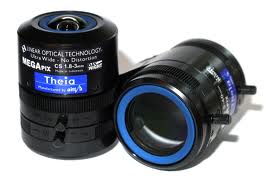
For an HDcctv box camera today, it makes sense to choose a CS-mount lens of appropriate resolution. Be careful never to fit an old CCTV lens to an HDcctv camera! The result would be fuzzier video than necessary, failing to take advantage of the high-definition sensor and ISP. Similarly, to the extent that higher-resolution lenses are more expensive, there may be no need to fit a very high resolution lens to an HDcctv camera, because that would be overkill. On the other hand, some buyers find better results with slightly over-spec lenses. For example, sometimes a lens rated at 5 megapixels might give better results than a lens rated at 3 megapixels for a 1080p25 camera, whose native resolution works out to 2.2 megapixels.
I wish there were a more prescriptive approach to lens selection. Ultimately, just as buyers find their own comfort levels with camera price and performance, so should buyers explore price/performance tradeoffs in lenses for HDcctv cameras. One thing is for sure: product availability continues to grow, so there are plenty of alternative HD lenses from which to choose.
HDcctv lenses
We say…………….So the above guidance on HDcctv lenses will help CCTV installers make some informed decisions on lens choice in order to get the very best images out of  HDcctv systems. More questions we have put to Todd will be published soon but if you have any comments or feedback on HDcctv lenses please let us know.

HDcctv . Why it will sell more cameras than IP CCTV in the UK.

How many miles of coaxial cable currently service CCTV camera systems here in the UK? No-one is sure and I would suggest that this has never been documented. But let’s consider some facts. CCTV has been actively sold into UK business’s on a large commercial scale since the early 1970′s and there is hundreds of thousands of miles of coax still servicing perfectly good CCTV systems right now.

Is HDcctv better than IP CCTV?

IP CCTV must not be discounted, in fact in most other countries across the world IP CCTV is selling well and we embrace this technology completely. But in the UK we have a slightly different scenario right now. We need HD solutions but not always delivered by IP. That’s why HDcctv could be the main technology installed in the UK over the next 10 years with the right investment and marketing.

HDcctv installers in the UK.

So what’s unique about the UK CCTV market place and why will HDcctv be so popular? Well, we have already mentioned the vast amount of legacy coax that is waiting to be used. In addition, as salesmen we hear the same story time and time again. Customers want quality images, customers want to be able to zoom in on an image, either in live mode or in recorded mode and see a face or see a number plate, they all hate poor images and no definition as it effectively renders current analogue CCTV systems useless. It is the biggest downfall of analogue CCTV. What’s more,  everyone in the UK knows it.

Cheap HDcctv?

So why don’t all these disgruntled customers go over to IP CCTV and megapixel cameras, surely that’s the way forward? Well again as we mentioned earlier there are a couple of factors here in the UK that are ideal for HDcctv that will enable this unique technology to find its footing.

There are very poor margins in analogue CCTV right now however….

HDcctv can give quality images but maintain current infrastructure, so costs can be kept right down in an upgrade situation. Secondly UK installers are struggling with IP installations. IP CCTV takes much more resource than many would care to admit. The plug and play concept of IP is not quite as its made out to be and most installers are finding it very difficult to get the co-operation of IT departments in order to get network points adjacent to cameras or use existing switches and networks. So much so, its now almost the norm with IP CCTV to run your own local network for the camera system and supply your own POE switch, this completely defeats the point of IP CCTV in many cases and makes the whole job far less profitable.

Servicing IP CCTV

Further problems still exist with servicing, If you have a national contract every engineer you have needs a laptop, IT training, remote access and current software and so the list goes on. Software conflicts are a complete nightmare and a CCTV installer without its own IT support will not be able to overcome many of the problems that are facing them. That’s why IP CCTV still has not taken off in the UK.

HDcctv sales

So how does HDcctv find its way into the mainstream security market place? Well here in the UK we have sales guys. Sales guys love to sell the sizzle! HD is a buzz word that consumers know and have seen at home on their own TV sets. All who have experienced this technology will agree that its quite brilliant in the quality of images that are provided. So straight away HDcctv is something the end user will feel comfortable with.

Price of HDcctv

Price of an HDcctv system is important. Again we all know we have to pay more for HD, this is already accepted by the end user, but if we are able to keep this cost reasonable by using an existing coax infrastructure then we have a sale. Add to this the fact that CCTV engineers don’t need re-training and will feel entirely at home with the installation then again we have a winner. No software, no laptops, no IT department to deal with. Just on and off site with maximum profit and no costly revisits to upgrade software or program an IP address. This means on going service will be easy and profitable… even more reason for the CCTV industry to embrace HDcctv.

HDCCTV alliance

Over the years we have been through a number of downturns in the UK economy and one industry that has ridden this better than most is the electronic security market place. It has long been the belief that as money gets tight and unemployment rises this can be a catalyst for crime to increase and for manned guarding to be cut back in preference to electronic security, mainly CCTV. This recession though has had a slightly different tilt on it. The influx of cheaper electronic security from the far east has badly hit the traditional suppliers and installers especially here in the UK. We have seen the demise and re-birth of Norbain, big players such as Pelco and March networks disappear almost without trace and analogue CCTV that had in reality reached the end of its natural reign suddenly have a renaissance in terms of sales.

HD CCTV UK
CCTV cameras

This though has come at a price to many involved in the business of CCTV. Margins are now small to non existent standards are dropping and quality is suffering. IP CCTV that many thought would be the making of the industry has really struggled to secure a foothold even with the added benefits of HD.

Is this a local problem though by which we mean one that is mainly UK based? It does seem to be. This does make sense though . The UK was a saturated market long before the rest of the world started to catch up. The hope was IP and HD CCTV solutions would drive the market forward. Consumers however are just making do. Service contracts are as hotly contested as ever but there are plenty of  opportunity for service based companies to make hay while upgrades are on hold.

There is some good news though. Security systems have a life on them and many old analogue DVRs out there are getting tired….very tired. Sooner now rather than later many companies are going to have to make a choice. To upgrade or to abandon their CCTV systems. Although a few may decide they can do without CCTV for the foreseeable future most will be thinking they have to start spending on infrastructure at some point and this decision cant be too far away.

So do they go IP or analogue or do they opt for HDcctv? This has been the perennial question now for sometime. The thinking has to be that some form of HD solution is the way forward. With some of the big IP CCTV players seemingly abandoning the UK market place in favour of big projects abroad perhaps an HDcctv upgrade using existing coax would be something that installer would be trying to pitch to end users. To do this however they need choice of both HDcctv cameras and DVRs and HDcctv equipment that is certified alliance kit seems to be reasonably hard to come by here in the UK.

HD SDI over coax

So the jury is out but HD cameras in one form or another will prove the way forward for the industry. All we need though is for someone to be able to tell us when ? Any thoughts?