When your company decides to invest in security, it is often CCTV that is considered first for your business, while you weigh up the pros and cons of the wide variation of systems on the market,the best possible technology and service is always the preference but will what for your money make your investment worthwhile.


Why Invest in HD CCTV?


Over the last 20 years or so anyone installing a CCTV system has had one real choice and that’s analogue. All too often we see poor quality images because people decide to buy cheap ,poor quality and this really defeats the object of a CCTV system in the first place a system that will provide little to no useful evidence. This will make it difficult to realistically use the captured images quite frankly a waste of everyone’s time.


In the case of  HD CCTV, this isn’t the case. The HD CCTV systems provide maximum clarity for minimum bandwidth. HDcctv technology allows the user the ability to capture unparalleled image detail, enabling the best chance of identifying people or watching processes within your organization. With more advanced HDcctv systems we can even find scene changes, missing objects and events much more easily and quickly.


Why is HD CCTV Better than Standard CCTV Cameras?


When it comes to prosecution or appealing to the public for information, HD CCTV provides the most useful form of evidence to present. Images are clear and can be zoomed in losing little clarity, cameras with up to 2 megapixels are the most popular although some cameras offer higher definition.


HDcctv images ensure you have information that you can see and trust. Meaning that your CCTV system is reliable when you need it and this makes it worth the investment.


HDcctv Surveillence is relevant for any business and provides the ability to accurately record a host of incidents including; theft, robbery, trespassing, accidents, injury and most importantly employee fraud. You won’t miss vital incidents with HDcctv cameras.


With the ability to see everything that’s going on, response can be swift and effective. If an accident occurs, you can get somebody to them as soon as possible. If a theft, assault or suspicious behaviour occurs, you are able to take the fastest and best course of action. Most HDcctv systems can also be viewed remotely via Android and Apple tablets and smartphones, this means your HD CCTV system can be viewed from any location.



Today we focus on a piece written by a fellow CCTV professional. It explains with clarity why we should be using more and more HDcctv products in the future and why HD SDi cameras are becoming so popular

Analog video security systems have been the industry standard of the video surveillance world since the CCTV systems first made an appearance on the commercial front some 40 years ago. Analogue CCTV systems are easy to install, simple to use, and costs have continued to fall over time making them extremely cost efficient as an option. But analog CCTV has one huge limitation – picture quality ! Despite this, installers have been reluctant to recommend  different solutions such as an IP/Network system. This type of system will enable the end user to get high definition video. Why then is this option not considered more often? It might be because of the complexity of networking systems. Or it could be the cost and labour element of re-cabling all your cameras from coax to Ethernet.

We now though have HD SDI CCTV. SDI security camera systems offer superb, detailed, high-definition video without the complexity or cost of an IP/Network system. They use the same coax cable as analog systems so a conversion to HD SDI is simple for most existing CCTV systems.

One popular solution being explored now is a hybrid solution. This is the mixture of HD SDi cameras and analogue on 1 DVR meaning you keep most of your existing infrastructure but upgrade to high def where and only where you need it.

Compare 2.1MP to VGA Resolution


Upgrading from Analog is Easy


“Keep the existing coax cable connection to the cameras and have a hybrid HDcctv system. In fact, keep as many VGA cameras as you want. In some locations, VGA is all the resolution you need. In locations where you want more image detail and the ability to digitally zoom in, like cash registers, doorways, petrol pumps, etc., simply swap out the old analog cameras for new HD-SDI cameras. BNC connectors make it easy.

At the DVR, you’ll need to swap out your old analog DVR for a new hybrid analog + SDI DVR. Again, BNC connectors make it “plug and play” easy.

The Advantages of HD-SDI camera

1.       Easy to upgrade to a hybrid HDcctv system

camera is designed for superior quality high resolution video up to 1920 x 1080i. The HD-SDI interface allows transmission of high definition video up to 200 meters over standard coaxial cable.

Keep the existing coax cable connection to the cameras. In fact, keep as many VGA cameras as you want. In some locations, VGA is all the resolution you need. In locations where you want more image detail and the ability to digitally zoom in, like cash registers, doorways, gas pumps, etc., simply swap out the old analog cameras for new HD-SDI cameras. BNC connectors make it easy.

At the DVR, you’ll need to swap out your old analog DVR for a new hybrid analog + SDI DVR. Again, BNC connectors make it “plug and play” easy.”

So the concept is easy . The cameras are excellent value and finally the end user gets the images and detail they need from their HDcctv system.


Andrew Rennison the new CCTV commissioner is government appointed. He has been putting his point across that he believes CCTV requires more regulation. He actually goes further than pondering more regulation and actually suggests that CCTV is “out of control” We are sure you will all agree this a  sweeping statement indeed!

So is CCTV out of control? This is a question also asked in the recent security briefing from IFSEC. References to the government backed legislation that seems to be pointing to far greater control over CCTV in public places is a highly contentious issue. We already have the data protection act and this has served us well over a number of years. Do we really need more CCTV regulation?

CCTV images of riotsCan we get a conviction from this kind of quality image? 
CCTV by its very nature is always going to rile certain individuals and human rights groups. It has always been a mystery to us why but the fact that you can be caught committing a crime and taken to court as result of cameras seems to offend certain types. It seems that those going about their business in a normal way and actively steering away from anti-social activity, vandalism and theft are not those who seem to complain. Perhaps the reason is that CCTV is perceived as poor quality and on many occasions useless. It fails far too often to pick up vital clues such as facial recognition and number plates, simple things that would make all the difference to convictions as a result of CCTVimages.

We believe the reason that their is a fuss building now and more CCTV regulation being demanded is the quality of pictures are about to get a whole lot better. HDcctv and HD IP cameras are of such good quality that images captured are now irrefutable . Faces are easily recognized and number plates are captured. As a result more convictions are beginning to follow.

We have no issue with proper HDcctv regulation. It favours good installers who invest in training, accreditation and sell quality equipment. It helps our industry and it only hinders those who seek to take short cuts. We do though feel very strongly that if a camera is in place it should be fit for purpose and now the technology is available all cameras should be upgraded to an HDcctv standard image of at least HD quality. This will help the industry , reduce crime , increase convictions and lead to a safer environment for us all.

What is 960H?

960H is a new standard for security cameras and security DVR’s that provides high resolution images using advanced image sensors. Security cameras capable of 960H produce an image that is 960 horizontal and 480 vertical pixels large (960×480).


What are the benefits of 960H?

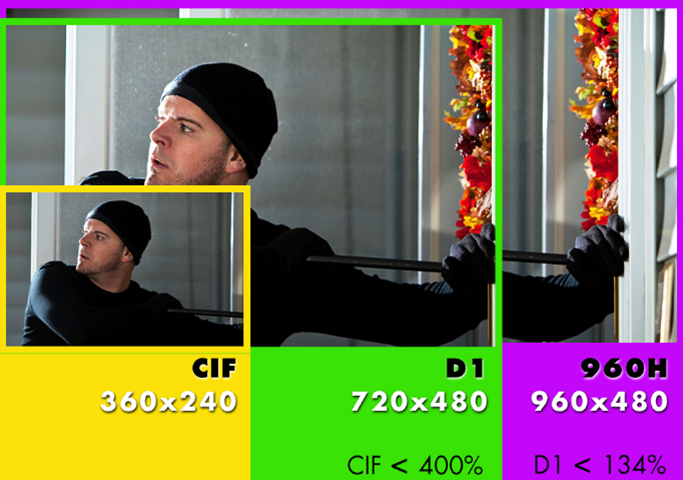
  • Higher Resolution Recording: Security cameras and DVR’s capable of recording at this resolution provide superior images that are 34% larger than D1 and more than 500% larger than CIF.960H vs. D1 vs. CIF
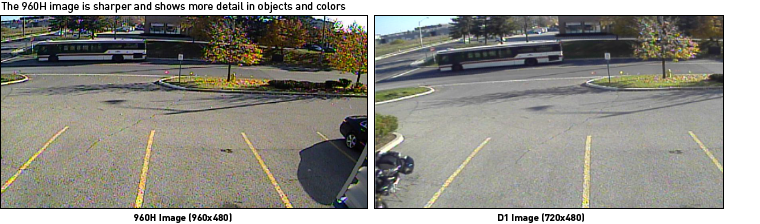
  • Better Image Quality: Recording larger images provides a greater amount of image detail. Images are sharper and it is easier to distinguish objects that are close together.960H image is sharper and shows more detail in objects and colors
  • True to Life: 960H creates a wide-screen picture that does not need to be stretched to fit wide-screen TV’s and monitors.960H provides true to life images without stretching
  • Easy to Upgrade: 960H systems use the same BNC video cabling as lower resolution systems. If you already have a security camera system, upgrading to 960H will save you time and money compared with IP camera systems that require rewiring.


What do I need to do to take advantage of 960H?

To take advantage of 960H recording, you will need security cameras that are capable of producing 960H images and a security DVR capable of recording at 960H resolution.


I already have a security camera system. Will my old equipment be compatible?

960H security cameras and DVR’s are backwards compatible with standard resolution cameras and DVR’s. However, both your security cameras and DVR must be 960H capable to get the improved picture quality and performance. 960H cameras will provide a good picture on a standard resolution DVR, but they will perform even better with a system that can support the full image size.

All your existing BNC video cables are compatible with 960H DVR’s and security cameras. To upgrade to 960H, simply replace your existing DVR and cameras.


What is the difference between 960H and Lorex’s HD security camera systems?

960H uses the same technology and cabling as traditional security camera systems. It simply uses superior camera image sensors to provide bigger, more detailed images, and more powerful DVR’s to record those images. Lorex’s HD security camera systems (for example the LHD100 Series) use HD-SDI technology to transmit digital, un-compressed high definition video over high-grade coaxial cabling, such as RG59. HD-SDI systems employ digital signals to transmit video. This means that they are not compatible with standard definition security cameras, DVR’s, or non-coaxial cabling.

So 960H is another step towards higher res pictures. It is another product that will see improved images for the end user. Is it a better option than HDcctv or IP? That’s difficult to say at this stage but as all these products challenge each other it can only drive prices downwards and that is great news for the consumer.


Although the cost of HD IP has reduced somewhat in the last few years it is still far more expensive as a technology than HD SDi or analogue. HDcctv solutions are soon to bring a camera into our range that will see an outdoor IP67 rated 2MP ONVIF compliant IP bullet camera that will prove very popular with installers looking to give an excellent value HD IP solution to their clients. Please click the link

The HD IP bullet camera with built in IR has some excellent advantages over a traditional IP box camera in a housing. Less bulky, far more aesthetically pleasing and no need for additional lighting keeps cost down and keeps the customer happy at the same time.

Why use IP though? Well each installation needs to specified on its merits. A site for instance that has a legacy coax infrastructure would suit HD SDI, however a new build or a new installation may well favour an HD IP solution. IP is flexible and can be powered over ethernet negating the need for expensive electrical work. The cameras can be focused from the PC and on board recording in the form of an SD card gives redundancy at the edge.

HD however is the driving force that is seeing CCTV sales increasing. After years of sticking plasters over traditional CCTV systems HD is a refreshing step forward for the industry. IP cameras can produce images beyond 29MP however in the industry it is widely accepted that cameras that operate between 1.3 and 5MP are the most cost effective way to produce perfectly acceptable HD images that are stunning in comparison to their analogue counterparts.

So a 2MP IP camera sits nicely in the middle of the range, a bullet camera with IR suits those who need an external view and POE means easier installation. A good reason to look at the IP HD camera range on the HDCCTV solutions website