Today we publish more of our fascinating interview with Todd Rockoff on the merits of HDcctv as a technology. It is fast becoming the most efficient and cost effective way of delivering HD images into the security market place. Today we touch on chip technology and how having some of the most innovative chip manufacturers on board is helping the HDcctv alliance build its brand and persuade more of the security community to accept that HD over coax is ultimately the best way forward for CCTV security professionals. For previous questions click here
6) We hear of major developments with regard to chip technology that
will make HDcctv both better and cheaper. Can you outline exactly what
the benefits will be and when it will be available?
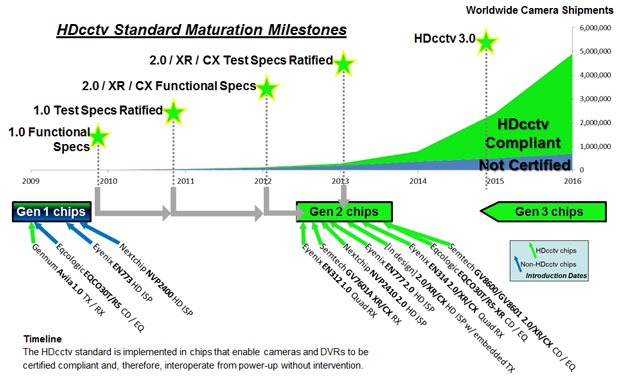
TR: Most of the leading semiconductor players in the surveillance industry, including two of the world’s top three ISP vendors, are implementing the features needed for HDcctv compliance in their current-generation chips. This industry development means that HDcctv compliance is becoming easier for device manufacturers to achieve.
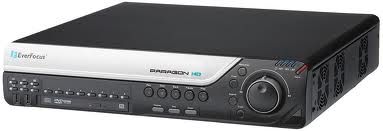
Meanwhile, more than one HDcctv Alliance chip-maker Member has developed a multi-channel receiver chip for HDcctv-compliant DVRs. Multi-channel receiver chips are part of the answer as to why CCTV DVRs are so cost effective. As the multi-channel receiver chips become readily available to HDcctv DVR makers, HDcctv DVRs will be better able to compete head-to-head with CCTV DVRs with respect to make cost.
Currently, most DVRs implement HDMI outputs. HDcctv is better for surveillance than HDMI, because it is less expensive per port and carries signals over longer distances. For these reasons, and as costs continue to come down as the industry scales the learning curve, native HDcctv monitors are expected to become increasingly popular.
7) You have campaigned long and hard to convince the industry that
HDcctv compliance is the way forward. Few disagree but is there signs
of more members coming on board and do you think by not joining
manufacturers who are just selling HD SDI without standardizing risk
being marginalized.
TR: The surveillance market is moving toward HD video, whatever the transport technology. We have campaigned long and hard to convince the industry that HDcctv is a superior alternative to MP IP cameras in many cases, and the fact that an outright majority of the world’s CCTV manufacturers has already embraced HDcctv in some form validates the HDcctv value proposition, which seemed so controversial just four years ago: HDcctv is easy to design and manufacture while cost-effectively delivering typically excellent end-user experiences.
Installers who buy surveillance equipment through distribution expect 100% multi-vendor interoperability and assured electrical performance. These properties are essential to be able to mix and match products from disparate manufacturers. Since distribution accounts for more than 80% of all cameras sold worldwide, these properties are economically significant. HDcctv compliance certification is the only way a manufacturer can warrant 100% multi-vendor interoperability and certain electrical performance. The various interpretations of HD-SDI get partway there, delivering HD video in some way, but there is no compliance certification regime for any of the HD-SDI variants.
The steady growth of the HDcctv Alliance reflects an inevitability that most manufacturers will ultimately seek HDcctv compliance certification for their HDcctv products, because testing to the international standard is required for a manufacturer to be able to warrant interoperability and electrical performance, and these properties are essential for sales through distribution. HD-SDI was developed to meet the needs of broadcast television studios, rather than surveillance. The need for compliance certification becomes even more important for those manufacturers seeking to take advantage of the advanced, surveillance-specific capabilities of HDcctv 2.0/CX/XR.
What does it mean for a manufacturer to ship a proprietary interpretation of HD-SDI instead of embracing HDcctv, the global standard? It may be that the manufacturer is grappling with the technical issues that inevitably arise for the first products in a new product category and has not yet placed a high priority on compliance certification. Ultimately, given that compliance certification is valuable and not intrinsically expensive, persistently refusing to certify compliance might raise questions in some buyers’ minds about the manufacturer’s overall commitment to quality.
8) This year at Ifsec the bias towards HD over coax was obvious and
Samsung are one of the big names we see that are almost reluctantly
deciding they have to join the fray. Why the reluctance originally on
their part?. Will they be joining the alliance? And are there other
big name manufacturers waiting in the wings to launch HDcctv over
coax?
TR: I cannot comment on any non-Member’s plans. In general, the fundamental economic considerations discussed above motivate every manufacturer hoping to sell HDcctv products through distribution to seek HDcctv compliance certification at some point during the manufacturing engineering cycle.
You raise a fascinating question that has significant implications for our industry: Despite a few notable exceptions, why have the incumbents largely abandoned the HDcctv market opportunity to more nimble competitors, in favour of focusing only on MP IP cameras? There certainly are situations where IP cameras are convenient and cost effective, but not every situation. After some 15 years of trying and failing to gain significant market share, the one area where IP cameras have been beating CCTV cameras in recent years has been HD surveillance. When MP IP cameras were the only option for HD surveillance, it was easy to mistake the market migration to HD surveillance as the beginnings of a long-awaited mass migration to IP cameras, and many companies built their long-term strategies around the ultimate dominance of IP cameras. It can be difficult for a company, having made a huge investment developing IP cameras and educating installers to use IP cameras in all cases, to consider an alternative, no matter that HDcctv is a more practical path to HD surveillance in many situations. That is one reason why the incumbents have been hesitant to embrace HDcctv. Meanwhile, smaller and more agile companies are delivering HDcctv solutions to meet the market need for HD without the I.T. issues introduced by IP cameras.
Ultimately, surveillance product innovation is delivered in semiconductors. The HDcctv Alliance includes about 15 chip-maker Members collaborating on defining the standard and implementing the standard’s features in their chips. As those chips become ever more widely available, expect an ever-growing number of equipment brands to begin to take advantage of the capabilities in their product lines.
HDcctv technology is already in the process of disrupting the competitive landscape in the surveillance industry: those failing to offer HDcctv solutions are missing out of one of the most dynamic product categories ever to hit the industry.
Thankyou Todd Integrated CCTV will have more of the interview and insight into the HDcctv alliance shortly
 One of the major issues with IR illuminators deployed to veiw just a small distance is image “white-out” this will invariably cause issues relating to over exposure in cameras. However the ILLUME range gives the flexibilty that allows intensity to be increased for longer distances, a major benefit for specifiers who suspect clients needs may change or where greater illumination is needed due to variants in lighting levels.The ILLUME WL, white light series, comprises of 3 units with viewing angles and illumination ranges of 10° by 50m, 30° by 30m and 60° by 15m. The ILLUME IR illuminators known as the infra-red series, also comprises 3 units, however these ir illuminators have viewing angles and illumination ranges of 10° by 100m, 30° by 60m and 60° by 30m. The range of ILLUME products is designed for external use and to this end all the illuminators come in robust, IP67 rated, high-quality, weatherproof housings. Single, double and triple mounting brackets are available, enabling narrow and wide angle settings for the double and triple.